
Why We Still Weave on Traditional Shuttle Looms
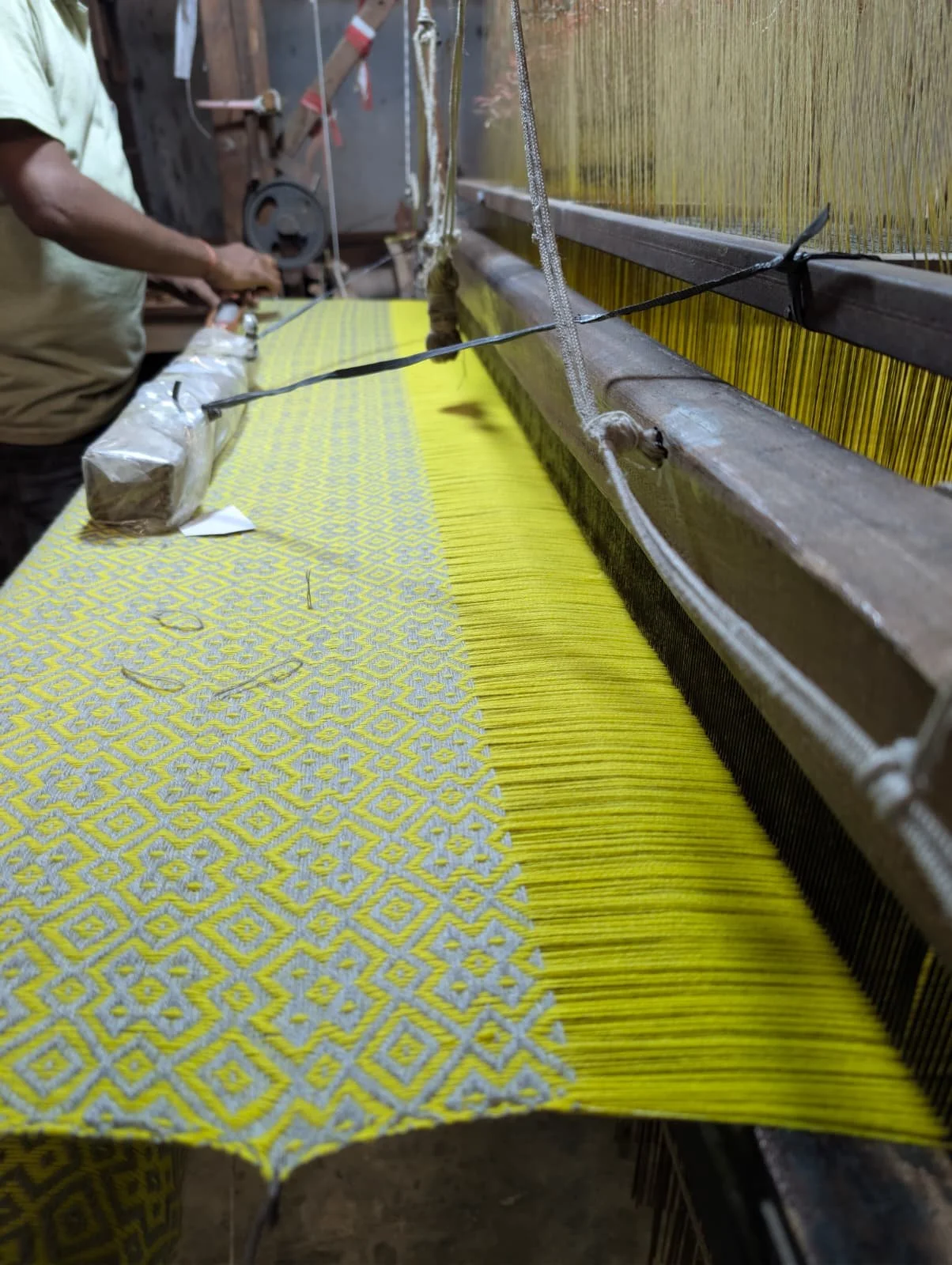
One of the questions we’re asked most often is:
"Why are you still weaving on traditional shuttle looms?"
It's a fair question.
Modern textile manufacturing has advanced enormously over the past few decades. Automated weaving technologies have made production faster, more efficient, and highly consistent. For many textile manufacturers, they're the ideal solution.
So why do we continue weaving on traditional shuttle looms?
The answer has less to do with tradition and more to do with the kind of work we do.
Manufacturing Should Match the Product
There is no single "best" way to manufacture textiles.
The right production method depends on the product being made and the needs of the customer.
If you're producing thousands of identical textiles with the same specifications, automated looms offer clear advantages. They can achieve remarkable speed, consistency, and efficiency at scale.
But our work is different.
At Arihant Collection, many of our projects are custom developed for interior designers, luxury retailers, and hospitality brands. One client may request a specific weave in a bespoke size. Another may need a custom color that matches an interior palette. The following project may require a completely different construction or only a small production run.
Every order has its own requirements.
That kind of variety calls for a different approach.
Why Flexibility Matters
Traditional shuttle looms give us the flexibility to adapt from one project to the next without forcing every order into a standardized production system.
A change in dimensions.
A new weave structure.
A different ply construction.
A unique color developed for a specific project.
These aren't exceptions in our work; they're part of our everyday process.
Because every project begins with different goals, we value equipment that allows us to respond to those differences rather than limiting them.
Custom Manufacturing Is About Adaptability
One of the strengths of traditional weaving is its ability to support bespoke development.
Instead of designing products around the capabilities of a machine, we can focus on the needs of the project itself.
This flexibility is particularly valuable when working with designers, who are often creating textiles for unique interiors rather than selecting from standard catalog products.
Whether it's a single prototype, a sampling program, or a production run with custom specifications, the manufacturing process needs to adapt to the design, not the other way around.
The Role of Skilled Craftspeople
A traditional loom is only one part of the equation.
Its true value comes from the experience of the people operating it.
Handwoven textiles rely on skilled craftspeople who understand how materials behave, how different weave structures influence the finished fabric, and how subtle adjustments can improve the final result.
That knowledge has been developed through years of experience.
While technology continues to improve manufacturing, there are still aspects of custom textile production where judgement, adaptability, and craftsmanship remain essential.
Technology Still Has an Important Place
Choosing traditional shuttle looms doesn't mean rejecting technology.
Quite the opposite.
Technology plays an important role throughout our workflow, from communication with clients and digital color references to production planning, sampling, quality control, and project management.
Modern tools help us work more efficiently and collaborate with clients around the world.
The weaving itself, however, remains intentionally hands-on because that's where flexibility matters most for the kind of products we create.
It's Not About Old Versus New
Discussions about manufacturing often present tradition and automation as opposing ideas.
In reality, they complement one another.
Automation excels where efficiency, repetition, and large production volumes are the priority.
Traditional weaving excels where customization, flexibility, and craftsmanship are central to the project.
Both approaches have their place.
The important question isn't which method is better.
It's which method is better suited to the product being created.
Choosing the Right Tool for the Job
At Arihant Collection, our clients rarely ask us to produce the greatest possible number of textiles in a day.
They're asking us to create something made specifically for their project.
That may mean a custom size.
A unique weave.
A carefully developed color.
Or a textile designed to complement a particular interior.
Traditional shuttle looms give us the flexibility to make those decisions without compromising the individuality of each piece.
For us, continuing to weave this way isn't about preserving the past.
It's about choosing the manufacturing method that best supports the work we do today.
And for custom handwoven cashmere, that's exactly what traditional shuttle looms continue to provide.
